No Driveway? From Wednesday You Can Run an EV Charging Cable Across the Pavement — Unless You Live Here
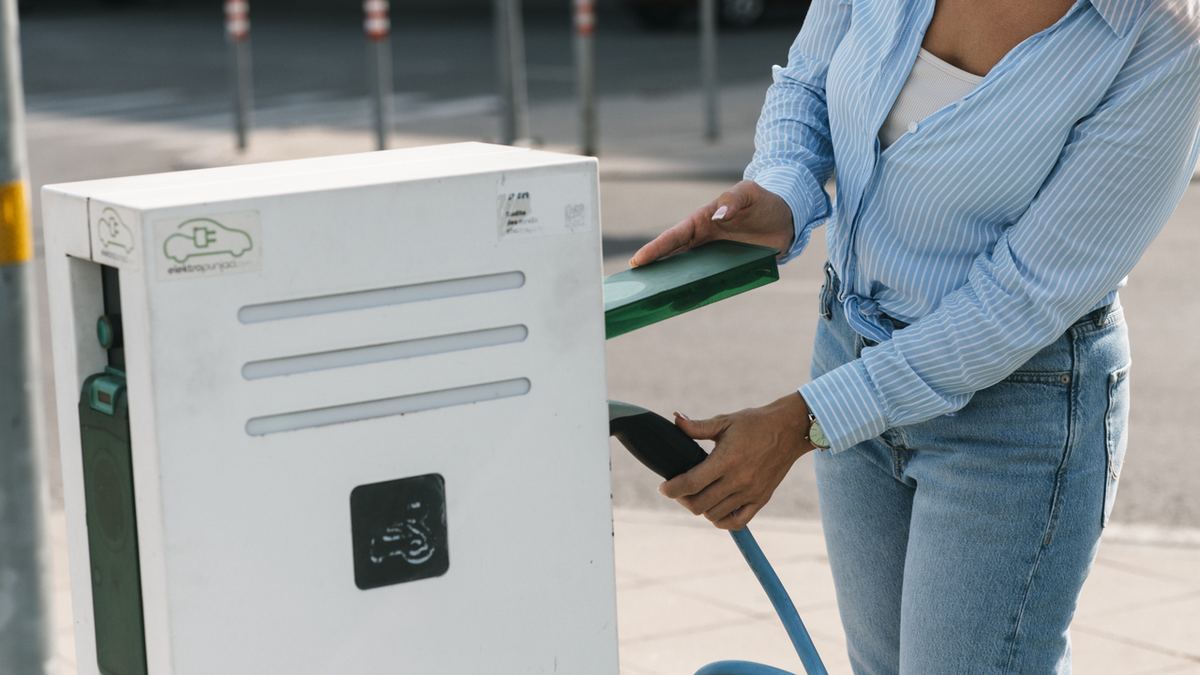
Photo: Shixart1985, CC BY 2.0, via Wikimedia Commons (representative image: a person charging an electric car at a street charging station).
If you own an electric car but not a driveway, you know the sting. Your neighbour with a garage charges at 7p a mile. You, parking at the kerb, pay public charger prices that can be double or more. From Wednesday, that unfair gap starts to close — though a late twist in the rules means millions of people won't get the benefit.
On 21 October, a new permitted development right comes into force in England. For the first time, households without off-street parking will be able to install a cross-pavement charging solution — typically a narrow channel set into the footpath to carry the cable below the surface — without applying for planning permission.
That matters because roughly 8 million households in England — about a third of the country, according to Department for Transport data — have no off-street parking. For them, cheap home charging has been out of reach.
How much could you actually save?
Charging at home typically costs around 7p a mile, according to The Times, compared with roughly 15p a mile on public chargers. And the gap is about to widen further. From 1 October, the government cut VAT on domestic electricity from 5% to 0%, while public charging stays at 20% VAT — a change experts say could save driveway owners up to £40 a year.
For the driveway-less, the sums are much bigger. Daniel Briggs, chief executive of Motorfinity, told reporters this week that "eight million households without driveways will have access to the cheaper overnight smart tariffs that they have missed out on for years," calling it "a big deal for the cost of EV ownership" that would also boost the second-hand electric car market. Some estimates suggest the saving versus daytime public charging could reach up to £1,000 a year for a regular driver.
The government has also put £25 million directly into cross-pavement solutions as part of a wider £381 million push on charging infrastructure.
The catch: conservation areas are shut out
Here is where it gets annoying. On 25 September — less than a month before the new right takes effect — the government amended the legislation to exclude England's roughly 10,000 conservation areas. Anyone living in one of them will still need full planning permission to install a cross-pavement channel.
Enjoyed this guide?
Britain Daily is an independent publication. Every guide is researched, written and carefully edited, and kept free forever. If this saved you time or made your life easier, please don't let the effort go unnoticed — support our work with whatever you can, from $1 upward. Every dollar keeps the guides coming.
💛 Donate via PayPalThe Times reported that about 6.8 million people live in England's conservation areas, roughly half of them without driveways — and with the national EV adoption rate, the exclusion could lock around 100,000 electric car owners out of the simpler process.
A government spokesperson defended the carve-out, telling The Times: "We want to support households without off-street parking to access domestic electric vehicle charging, but it's vital that we continue to protect the special character of our conservation areas."
What the rule doesn't do
It is worth reading the small print before you start eyeing up your pavement. The new right removes the planning permission step only — you still need your highway authority's authorisation, and you cannot just cut into the footpath yourself. The channel carries no right to reserve the parking space outside your house either.
Daniel Briggs has also warned that the system could become "a postcode lottery of enforcement," with approval speeds varying sharply depending on the council, since there is no national standard for safe cross-pavement installations.
A video note
We couldn't find a current, reputable news-outlet video specifically on this week's rule change, so we're not embedding one — better no video than a misleading one.
Why this still matters
Strip away the caveats and this is genuinely the biggest fix to the "driveway divide" in years. Home charging is where almost all the running-cost savings of an electric car come from, and until now those savings have been hardest to reach for exactly the drivers who needed them most.
Wednesday's change won't fix everything overnight. But if your only objection to an EV was "I'd love one, but I've nowhere to plug it in," the strongest excuse on the list just got a lot weaker — unless you happen to live in one of England's conservation areas, in which case the fight goes on.
Sources
Reporting draws on The Times' coverage of the conservation-area exclusion (October 2026), AOL's original report on the October rule changes, Motoring Chronicle's analysis of the excluded areas, the Liverpool Echo's reporting on Motorfinity chief executive Daniel Briggs's comments, and LoveElectric's breakdown of the planning rules. According to The Times, around 100,000 EV owners in conservation areas will need full planning permission; according to Motorfinity, eight million driveway-less households stand to gain access to cheaper tariffs.
Enjoyed this guide?
Britain Daily is an independent publication. Every guide is researched, written and carefully edited, and kept free forever. If this saved you time or made your life easier, please don't let the effort go unnoticed — support our work with whatever you can, from $1 upward. Every dollar keeps the guides coming.
💛 Donate via PayPal