Ukraine's Starshield Is Back Online: Kyiv Confirms Military Satellite Service Restored After 100mph Speed-Cap Chaos
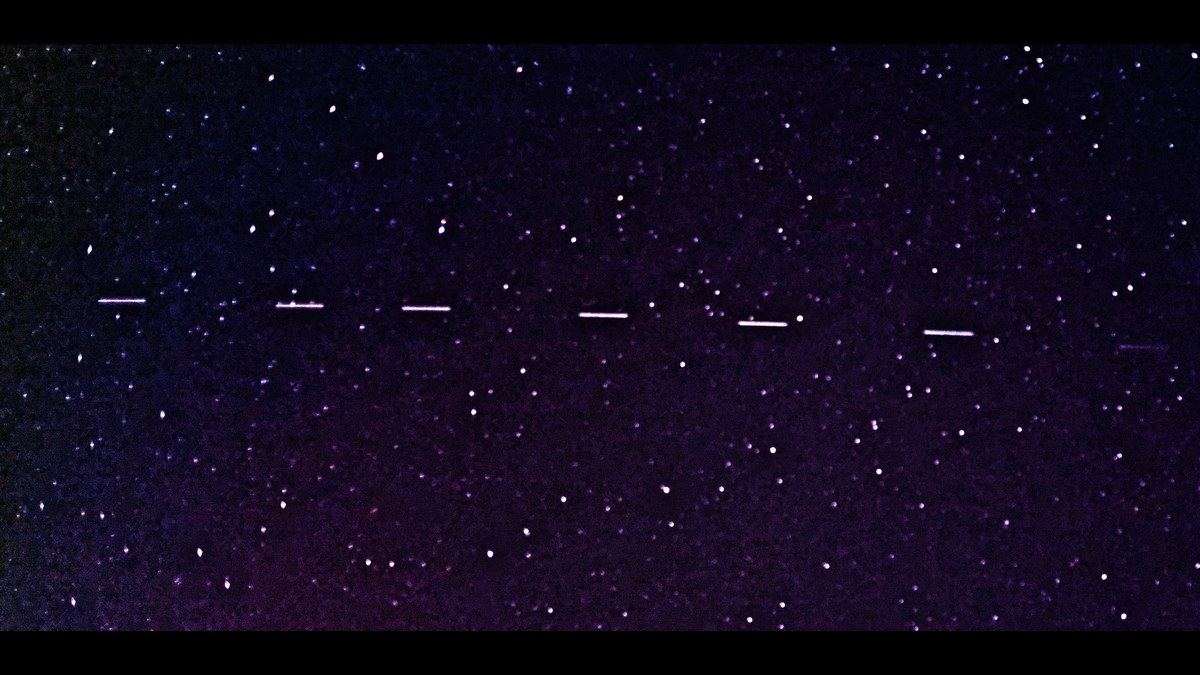
File photo: a train of Starlink satellites crosses the night sky — CC BY-SA 4.0, Wikimedia Commons (Jud McCraine). (File photo, not from Ukraine.)
For roughly 48 hours, Ukraine's drone crews were flying half-blind. Then, almost as suddenly as it had vanished, the signal came back.
A source in Ukraine's defence ministry confirmed on Thursday that Starshield — the military-grade sibling of Elon Musk's Starlink satellite network — is working again for terminals on the move. "As of now, Starshield service while on the move has been restored and remains operational," the source told the Kyiv Independent. "We have confirmed this through reports from our units." Ukrainska Pravda, citing its own defence ministry sources, reported the same: performance is "continuing to improve."
The restoration ends two days of genuine panic in Kyiv — and a very public row between Volodymyr Zelensky and Musk that spilled across X, television studios, and, on Wednesday, the corridors of Downing Street.
What actually broke
It started with a speed limit. Serhii "Flash" Beskrestnov, a radio-technology expert who advises Zelensky, reported that Starshield terminals mounted on moving platforms — the guidance systems on Ukraine's strike drones — had been throttled to 100mph. At that cap, Beskrestnov said, the terminals were effectively useless for guiding drones in flight.
For an army that leans on drones the way Ukraine does — for reconnaissance, for mid-range strikes on Russian-occupied territory, for guiding interceptor missiles — that is not a glitch. It is a missing limb. Al Jazeera notes that Kyiv is still pressing SpaceX and Washington for an explanation of what happened between Tuesday and Wednesday.
Musk: "not my call" — then a jab at Zelensky
Musk moved fast to distance himself. "Starshield systems are owned and controlled by the US government," he wrote on X. "Any limits on speed or usage are decided by the US military and ultimately Potus." In other words: talk to the Pentagon, and the President.
Enjoyed this guide?
Britain Daily is an independent publication. Every guide is researched, written and carefully edited, and kept free forever. If this saved you time or made your life easier, please don't let the effort go unnoticed — support our work with whatever you can, from $1 upward. Every dollar keeps the guides coming.
💛 Donate via PayPalThen he went further. In an overnight post, Musk suggested Zelensky himself was to blame for the absence of a negotiated settlement to end the war — and declared it was "time for Zelensky to go." That is quite a sentence from the man whose satellites carry Ukraine's battlefield internet.
Zelensky, for his part, did not mince words either. In an interview with Piers Morgan, he said he felt "betrayed" by the United States over the throttled access, warning that "people will die" as a result. Hours later he was in London — 25 minutes with the King at Buckingham Palace, then a welcome at Downing Street from Prime Minister Andy Burnham. The timing was hardly accidental.
Why Starshield matters more than Starlink here
Quick primer, because the names blur: Starlink is the commercial satellite-internet constellation — some 11,000 satellites in low Earth orbit beaming broadband to remote places. Starshield, launched in 2022, is its hardened military cousin: deeper encryption, built for governments, and, per SpaceX, used primarily by US defence agencies and "government partners." Ukraine is one of those partners, and its military depends on Starshield's encrypted links to fly drones and coordinate strikes. It does not operate inside Russia, so it plays no role in the deep strikes on Russian refineries — but over Ukrainian-held and occupied territory, it is the nervous system of the drone war.
Which is exactly why a 100mph cap on moving terminals landed like a bombshell: a drone doing 120mph with a terminal capped at 100 is a very expensive paperweight.
The questions that are still open
Restoration is not resolution. Ukraine's defence ministry says it is still "continuing its engagement to clarify all the reasons and circumstances surrounding yesterday's restrictions," and is now surveying frontline units about the speeds Starshield is actually delivering. Kyiv wants to know who ordered the cap, why, and whether it can happen again without warning.
There is also the wider weather. The Starshield row erupted in the same week Trump temporarily lifted sanctions on Russian diesel — a move Zelensky, European governments, and several Republican senators all condemned — and as Washington weighs easing sanctions on the "shadow fleet" tankers carrying Russian, Iranian, and Venezuelan oil. From Kyiv's vantage point, the pattern looks uncomfortably consistent: American leverage, applied at Ukraine's expense.
For now, though, the drones are guided again. In a war increasingly fought by machines talking to satellites, that counts as good news — even if nobody in Kyiv is celebrating just yet.
Sources
- Al Jazeera — "What is Starshield, and who limited Ukraine's access to it?" (15 October 2026)
- The Times — "Ukraine 'has run out of Patriot interceptor missiles'" (includes defence-ministry restoration confirmation, 15–16 October 2026)
- Ukrainska Pravda — "Starshield services on the move in Ukraine resume after Starlink restriction" (15 October 2026)
Enjoyed this guide?
Britain Daily is an independent publication. Every guide is researched, written and carefully edited, and kept free forever. If this saved you time or made your life easier, please don't let the effort go unnoticed — support our work with whatever you can, from $1 upward. Every dollar keeps the guides coming.
💛 Donate via PayPal